Most leaders think high performance is about hiring the right people, using the right tools, and running the right process.
It is not.
High performance is a culture. And culture is built long before the project starts, long before the first deadline, and long before anyone is under pressure.
The teams that perform at the highest level do not need to be managed. They need to be led. There is a difference, and most organizations never figure it out.
The Difference Between Managing and Leading
Managing is reactive. It is checking in, following up, chasing updates, and making sure nobody drops the ball. It is exhausting for the leader and insulting to the team.
Leading is proactive. It is setting the standard, building the culture, and trusting the team to execute inside that framework without hovering over every decision.
One creates dependency. The other creates performance.
The leaders who manage are always busy. The leaders who lead are always dangerous. Because their team runs without them, and that is exactly the point.
The leaders who truly lead become force multipliers.
Feeding the Bear
The highest performing teams I have ever been a part of shared one thing that nobody talks about.
Information flow.
Not just good communication. Not just regular updates. I mean information moving so freely, so consistently, and at such a high level that leadership never has to ask a question. Because by the time they think of it, the answer is already there.
We called it feeding the bear.
The bear is always hungry. Leadership, stakeholders, clients, ownership. They always want to know what is happening, where things stand, and what is coming next.
A reactive team waits to be asked. Then scrambles to answer.
A high-performing team feeds the bear before it gets hungry. The update goes out before the question comes in. The problem gets surfaced before it becomes a crisis. The stakeholder feels informed before they feel anxious.
That is not just communication. That is trust at scale.
When information flows that well, micromanagement becomes impossible. Not because the leader decided to back off. Because there is nothing left to chase.
Fire and Forget
In high-stakes operational environments there is a concept called fire and forget.
You do not launch something and then chase it. You build it right, aim it correctly, trust the system, and let it go.
That is how I build teams.
You set the standard before the work starts. You define what ownership looks like. You have the uncomfortable conversations early so nobody is surprised later. You build a culture where accountability is not enforced from the top but expected from within.
And then you let go.
Not because you stopped caring. Because you built something that does not need you to function. The team knows the standard. They know what winning looks like. They know how information flows and who owns what.
Fire and forget.
But fire and forget only works if you did the work before you pulled the trigger.
That starts with the people. You cannot build a fire and forget culture with the wrong team.
When you build the right team, something different happens.
The standard becomes self-enforcing. Nobody has to chase accountability because the people around you will not tolerate anything less than their own standard. You are motivated to be your best not because leadership is watching but because the people next to you are already operating at a level that makes anything less feel out of place.
Iron sharpens iron.
That culture does not come from a policy, a meeting, or a values statement on the wall. It comes from deliberate selection, intentional training, and a leader who holds the line on the standard long enough for the team to make it their own.
You train them until the standard is instinct. You build the culture until accountability is automatic. You develop the trust until information flows without being asked.
And then you fire and forget.
Not because you stopped leading. Because you built something that leads itself.
What This Actually Requires
This does not happen by accident. It requires a leader willing to do the hard work upfront that most leaders avoid.
Defining the standard before anyone misses it. Having the conversation before it becomes a conflict. Building the information culture before the project falls behind. Assigning ownership before assumptions fill the gap.
Most leaders want the result of a high-performing team without doing the foundational work that creates one.
That is why most teams are managed instead of led.
The Standard is the Floor
I tell everyone I lead and mentor the same thing.
The standard is the floor. Not the ceiling.
Anyone can hit the floor. Extraordinary lives in the hard, painful, and difficult. Where others are unwilling to go.
A high-performing team does not just meet the standard. They make the standard feel like the starting line.
Fire and forget is not a management style. It is the result of a leader who did the work before anyone was watching.
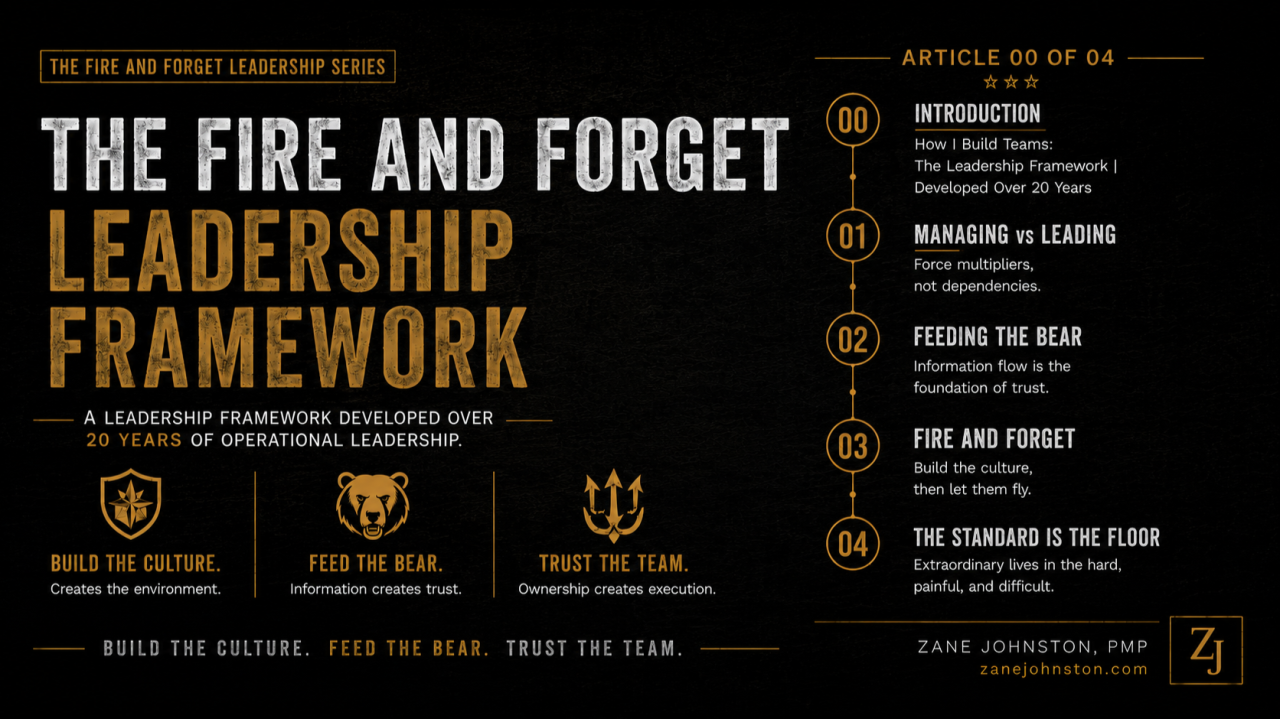
Build the culture. Feed the bear. Trust the team.
That is what high-performing looks like.
What is Coming Next
This is the first in a series of articles breaking down each piece of this framework in depth.
Next up: the difference between managing and leading, and why that distinction will define your career, your team, and everything you build.
If this resonated, follow along. The best is still ahead.
Always Forward.