Nobody wakes up in the morning wanting to be managed.
Think about that for a second.
No one sets their alarm, gets out of bed, and thinks, Man, I hope someone tells me exactly what to do today, monitors everything I produce, and makes sure I stay inside the lines.
That is not how people are wired.
People wake up wanting to matter. They want to contribute. They want ownership over something worth showing up for. They want to be part of a culture built to bring out their best.
And yet most organizations are built almost entirely around management.
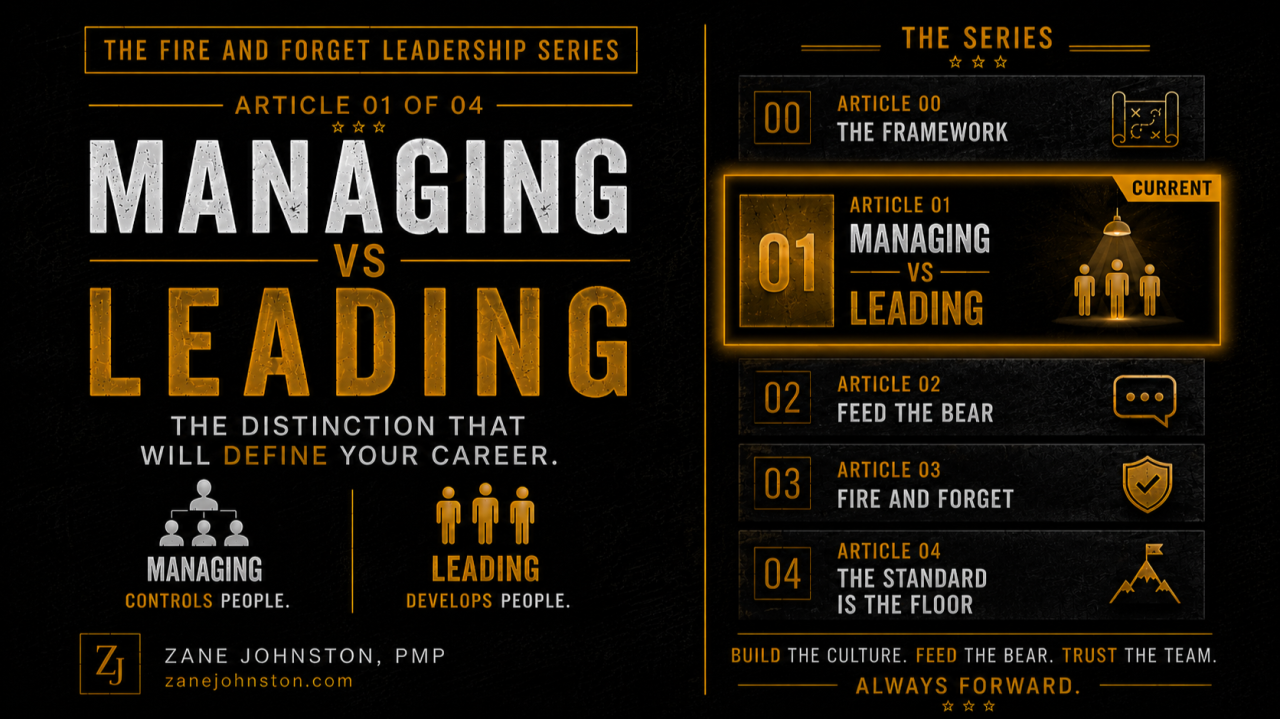
The leader who manages will always be the bottleneck. The leader who leads becomes a force multiplier. Understanding the difference starts here.
Earlier in this series, I said the difference between managing and leading is simple. Managing is reactive. Leadership is proactive.
At the time, I was introducing the idea. This is where we go deeper.
The Contrast That Changed Everything
I did not learn what leadership was by just reading about it.
I learned what it was by feeling the difference between being in a room where it existed and being in a room where it did not.
One environment felt heavy.
Not because the work was hard.
Because the culture was built around compliance rather than confidence.
Around checking boxes rather than developing people.
When things went wrong, the instinct was to look outward rather than inward for accountability.
The other felt alive.
The work was harder.
The stakes were higher.
But for the first time I was around leaders who looked inward first.
Who owned the outcome before they ever looked at the team.
Who understood that if the team was failing, the leader had already failed first.
That difference changed everything.
Not just how I led.
But how I thought about leadership.
Looking back, I realized the difference was not just personality.
It was philosophy.
One leader reacted to problems after they appeared.
The other built the kind of team that prevented them from happening in the first place.
One managed.
The other led.
You do not fully understand what leadership is until you have felt both sides of that contrast.
Once someone trusts you enough to let you perform without standing over your shoulder, you feel the difference in your bones.
And once you've felt it, you never want to lead any other way.
That is the culture worth building.
Where people perform to the standard not because they are managed to it, but because they have made it their own.
Once you feel both sides of that, you do not need anyone to tell you which kind of leader to become.
You already know.
You Can Manage a Process. You Cannot Manage a Person.
This is the distinction most leaders never learn.
You can manage a project, a schedule, a budget, a process, a system, or a workflow. Those things do not have feelings, motivations, fears, or ambitions. They respond to inputs and produce outputs.
The problem is that most "leaders" do not stop there.
They take the same approach they use on projects and processes and apply it to people.
That is called micromanagement.
And nobody on the planet wakes up motivated to be micromanaged.
It does not always show up as someone standing over your shoulder. Sometimes it is subtler than that.
It is the leader who asks for another update when nothing has changed. Not because they need the information, but because they do not trust the people doing the work.
Management reacts to uncertainty by creating more oversight. Leadership reduces uncertainty before it ever becomes a problem by building better people, clearer standards, and stronger teams.
It is the approval process that requires three signatures for a decision that one person is fully qualified to make.
It is the culture where nothing moves until it gets blessed from the top. Not because the top has better information, but because the top does not trust the people below them to get it right.
Over time, people in that environment learn something.
Their judgment does not matter.
Their initiative will be second-guessed.
The safest move is to wait for direction rather than take ownership.
So they wait.
The person who would have stormed the beach with you becomes the person who would rather stay in bed.
Not because they lost their drive.
But because the environment drained it out of them, one inspection, one approval request, one unnecessary follow-up at a time.
That is what micromanagement actually costs.
Not productivity.
Not efficiency.
The initiative, the ownership, and the trust that make a team capable of performing without you. That's the cost.
You cannot micromanage your way to a high-performing team.
You can only lead your way there.
When you walk into a room where the culture was built right, you feel it before anyone says a word.
The energy is different.
Not louder.
Not more chaotic.
Just focused.
Confident.
Everyone knows why they are there.
They know they are good at their job.
And they know their leader knows it too.
That confidence does not come from a pep talk or a poster on the wall.
It comes from a leader who prepared the team, trusted the team, and then got out of the way.
People stop waiting to be told what to do.
They start taking ownership.
They have put in the work.
They know the standard.
Now it is game time.
People are capable of far more than they realize when someone believes in them and trusts them to perform.
That is what leading actually produces.
That is not management.
That is leadership.
And the difference between the two is not a title or a rank.
It is the responsibility to build the environment, develop the people, and create the conditions for everyone around you to kick ass.
Leadership Is Not a Promotion. It Is a Practice.
Most people wait for permission to lead.
They wait for the title.
The promotion.
The moment someone officially puts them in charge.
Do not wait.
Leadership is a skill that develops through repetition and experience at every level.
You do not have to be a CEO to lead.
You do not have to manage a team of fifty to start building the instincts.
Every environment you operate in adds another tool to your toolbox.
Every leader you observe is teaching you something.
When the opportunity to lead at a higher level finally comes, you will not be starting from scratch.
You will be pulling from years of observation, experience, and deliberate practice.
Leaders will lead.
The Best Leaders Are Always Students
Every great leader I have ever been around shares one thing.
They study it.
Constantly.
But studying leadership is not just about books, talks, and articles.
The most valuable classroom I ever found was my environment.
Every leader you work under, work alongside, or observe is teaching you something.
Not always intentionally.
Not always positively.
But always.
Some of them you watch and think, that is exactly how I want to lead.
You pick up that tool and put it in your box.
Others you watch and think, I will never do it that way.
You pick up that tool too.
Because knowing what you do not want to be is just as valuable as knowing what you do.
You figure out which tools to keep, which ones to sharpen, and which ones to put down.
That is how a leadership style actually develops.
Not from one book.
Not from one mentor.
Not from one article series.
But from years of being a student of every environment you walk into and every leader you encounter along the way.
This series is not a one-size-fits-all prescription for leadership.
It is one methodology built from twenty years of observing high-performing teams, picking up tools from leaders across every environment I have been in, and refining what actually works when the stakes are real.
Take what resonates.
Leave what does not.
Add it to your own box.
The best leaders I know never consider themselves experts.
They consider themselves students.
And they never stop picking up tools.
The Responsibility
Management is a function.
Leadership is a responsibility.
Not just any responsibility.
One of the greatest you will ever carry.
The moment you step into a leadership role, you are no longer just accountable for your own performance.
You are accountable for the conditions that determine whether the people around you can perform at their best.
That is not a small thing.
Nobody wakes up wanting to be managed.
But people will run through walls for a leader they trust.
Be that leader.
Build the culture.
Feed the bear.
Trust the team.
The team no longer depends on the leader to perform.
The leader becomes a force multiplier.
That is leadership.
Always forward.