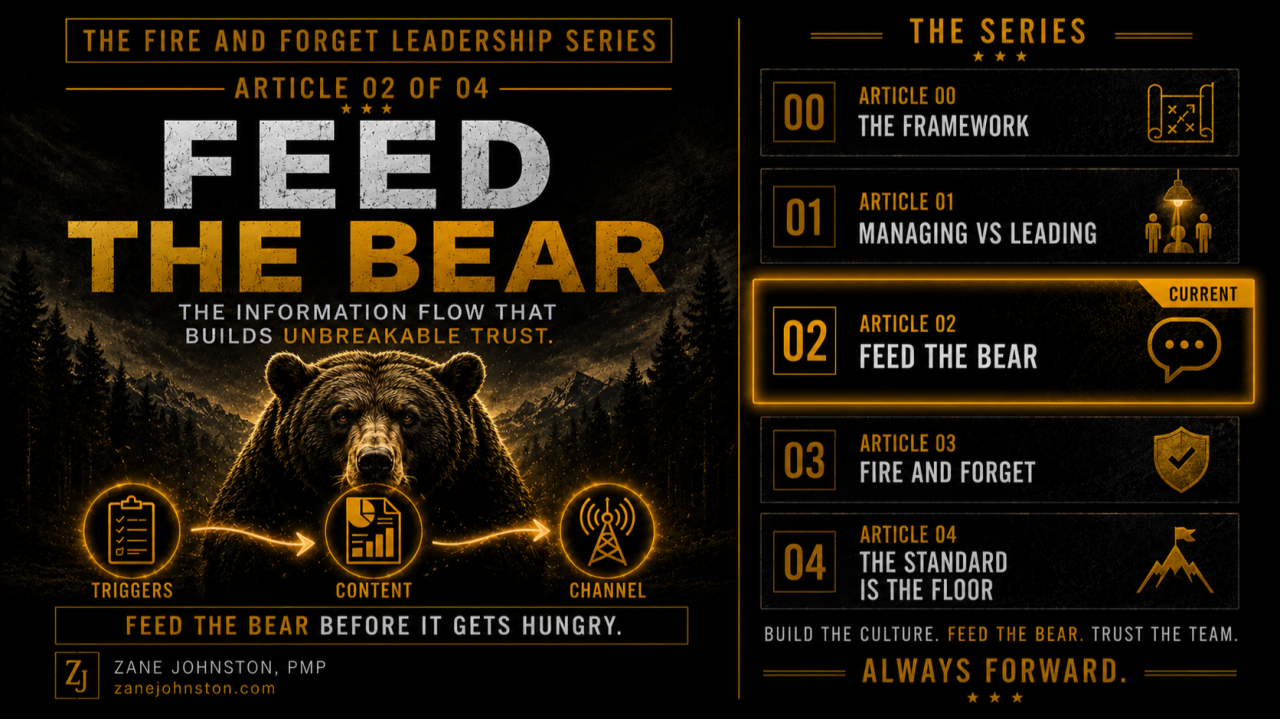
The bear is always hungry.
Leadership. Stakeholders. Clients. Ownership. They always want to know what is happening, where things stand, and what is coming next.
That never changes. The appetite is constant.
What changes is whether your team feeds the bear or waits for it to come looking.
The best teams I have ever been around never waited.
Think about a surgeon in the middle of an operation. They reach their hand out and before they say a word the right instrument is already there. The surgical tech did not read their mind. They understood the procedure, the sequence, and the surgeon well enough to anticipate the next move.
That is feeding the bear.
Not reactive. Not even responsive.
Anticipatory.
What Feeding the Bear Actually Means
Feeding the bear is not about sending more updates or holding more meetings.
It is about knowing your leadership, your team, and your stakeholders so well that you understand what they need before they know they need it.
But that understanding does not appear on its own. Someone has to build it. And that responsibility starts with the leader.
In high-stakes operational environments information was never left to chance. When leadership walked into the room the picture was already there. Current. Complete. No questions needed. The team did not wait to be asked because the standard was clear before anything happened. Everyone knew what information mattered, when it needed to move, and how it needed to travel.
That same discipline translates directly into any team and any environment.
It starts with three things.
First, define the triggers. Not just routine reporting but the specific conditions that require an update. The threshold looks different in every environment but the discipline is the same. If a timeline shifts by fifteen minutes in either direction that is a trigger. If a dependency changes that is a trigger. If something the leader counted on is no longer true that is a trigger. Define those conditions in advance so the team never has to guess whether something is worth surfacing.
Second, define the content. An update is not just that something changed. It is what changed, why it changed, and what the impact is. A team that delivers complete information gives leadership what they need to make a decision. A team that delivers incomplete information creates more questions than it answers.
Third, define the channel. Some things are fine by email. Some things require a phone call. Some things require a knock on the door right now regardless of the hour. The channel has to match the urgency and the leader defines that escalation standard clearly so the team never has to guess which one to use. In high stakes environments commanding officers put out standing orders that defined exactly what conditions required waking them up in the middle of the night. That is not bureaucracy. That is a team that knows precisely how to feed the bear at every hour and every threat level. The civilian equivalent is the same principle. Define the threshold. Define the channel. Eliminate the guesswork.
Triggers. Content. Channel.
Define all three and the team has everything they need to feed the bear before it gets hungry. Without that clarity the most motivated team in the world defaults to waiting to be asked. Not because they are disengaged. Because nobody told them what proactive looks like.
That is on the leader. Not the team.
Why the Bear Goes Hungry
There are two reasons information stops flowing and both of them start with leadership.
The first is how information was received.
When a leader responds poorly to an update, whether it is bad news, an honest mistake, or a problem surfaced early, the team learns something. They learn that sharing information carries a cost. And once that lesson is learned it does not go away easily.
The team does not stop communicating because they stopped caring. They stop communicating because the environment taught them it was safer to wait.
The leader who never gets information is often the same leader who made it uncomfortable to give it.
The second reason is clarity.
A team cannot feed the bear if nobody told them what the bear eats.
Most people do not withhold information intentionally. They withhold it because they are genuinely unsure whether it rises to the level of something leadership needs to know. They do not want to waste anyone's time. They do not want to look like they cannot handle things. So they make a judgment call and they stay quiet.
That judgment call is the gap.
When the leader has defined the standard clearly enough that the team never has to make that judgment call on their own, the information starts flowing. Not because people changed. Because the ambiguity that was stopping them got removed.
Most people want to perform well. They just need to know what performance looks like.
What Changes When It Works
When information flows the way it should, something shifts in the entire team dynamic.
Leadership stops chasing.
Not because they stopped caring about the details. Because the details are already handled. The update landed before they thought to ask. The problem got surfaced before it had time to compound. The stakeholder got an answer before they felt the need to follow up.
Leadership is no longer operating in the dark. They are operating with a complete picture. And a leader who operates with a complete picture does not need to micromanage. They do not need to hover. They do not need to chase.
They can lead at the level they are actually supposed to lead at.
Because the team below them is handling everything that used to pull them down into the details.
That is when the fire and forget culture becomes real.
You built the standard. The team executes it. The information flows. And the whole system runs the way it was designed to run.
Not because everyone is working harder.
Because everyone knows what the bear needs.
And they feed it before it gets hungry.
The Responsibility Goes Both Ways
Most leaders do not know their team has gone quiet.
They are too busy chasing the information that stopped coming to notice when it stopped.
That is the weight of this.
Right now, somewhere on your team, someone made a judgment call about whether something was worth surfacing. They thought about it. They weighed the risk. And they decided it was safer to stay quiet.
You may never know what they held back.
That is what an environment without a clear standard produces. Not a disengaged team. Not a lazy team. A team that learned, through experience, that the cost of sharing was higher than the cost of silence.
That is on the leader.
But here is the other side of it.
The moment you define the standard, something changes. The moment the team knows what triggers an update, what that update needs to contain, and how it needs to travel, the ambiguity disappears. And when the ambiguity disappears, people perform.
Not because you demanded it.
Because you finally gave them what they needed to deliver it.
That is the possibility inside this concept. A team that never makes you wonder. A culture where the information flows before you think to ask for it. A leader who can operate at the level they are actually supposed to operate at because the system below them is running the way it was built to run.
The bear does not have to be hungry.
You just have to decide to feed it.
Build the culture. Feed the bear. Trust the team.
This is Article 02 of the Fire and Forget Leadership Series. Next up: Fire and Forget. How to build a team that executes without you having to manage every move.
Always forward.